What to Do With Old Canvases
Simon Bland: 12 Jun 2026
Part of the reality of being an artist is that you get to create lots of paintings that just don't work. I often have to wrestle with my own ego before I can admit that something looks bad but when I eventually do, scraping off the offending paint is usually a relief. While it's easy to do when the paint is fresh, dry, hard paint is a different matter. Like most artists, I have tried sanding down and painting over old canvases, sometimes doing it more than once, but there are many reasons why this is not a good idea, not least of which it can be bad for your health.
In this article, I've provided some suggestions for what to do with the pile of old canvases and panels that will eventually be piling up in your studio. Not everything is worth saving, but some canvases can be repurposed.
In all the following examples, the original paintings were either unvarnished, or the varnish had been removed (I use a modern synthetic varnish which is not suitable for painting over). Painting over retouch varnish shouldn't cause any problems.
1. (Dry/Semi-Dry, Small) Limited Scrape and Repaint
In an ideal world, as soon as we step back from a finished painting, we would immediately see all the flaws and fix them. In the real world, what usually happens is that we end up in a debate with ourselves over whether or not something is wrong. Ego gets in the way, the paint start to dry, and what could have been a 5-minute fix turns into much more of a challenge. We move on to the next painting and put the failure in a cupboard.
That's how it goes for me, at least. And that why I had a stack of crappy paintings stuffed away on a shelf.
When I plan on reusing a canvas for a painting that I intend to sell, my goal is to keep what I can and rework only what is needed to improve the painting. This is especially true when paint has started to dry to the point where it takes a lot of effort to remove it. Scraping off the entire paint surface is often not possible and because I want to ensure that any reuse doesn't compromise the integrity of the final paint layers, reusing canvas doesn't always make sense.
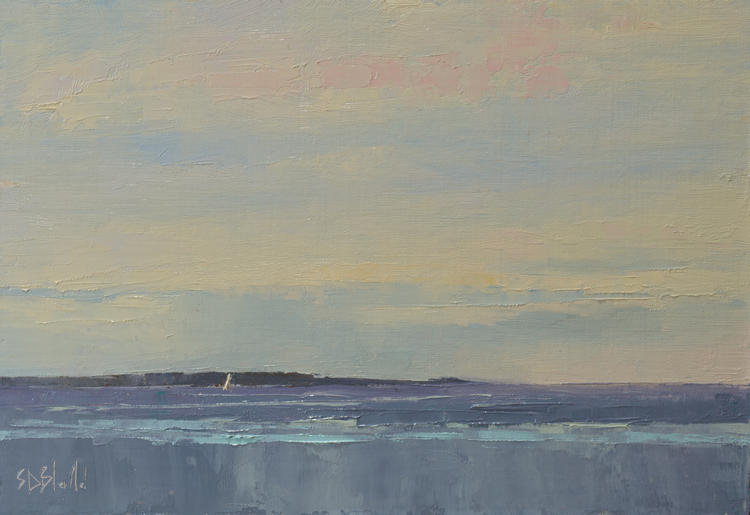
Plein air painting done at Carkeek Park, Seattle. 10x10, oil on linen panel.
From a compositional standpoint, the painting wasn't substantially flawed, and the color scheme looked OK, albeit a little too warm in the sky, but I thought the picture overall could be more consistent.
It's important to note that this painting was made without the use of any cadmium yellows or cadmium reds. In fact, all the paints I used had the ACMI Approved Product (AP) label. I don't recommend sanding down any paints that have an ACMI Cautionary Label (CL).
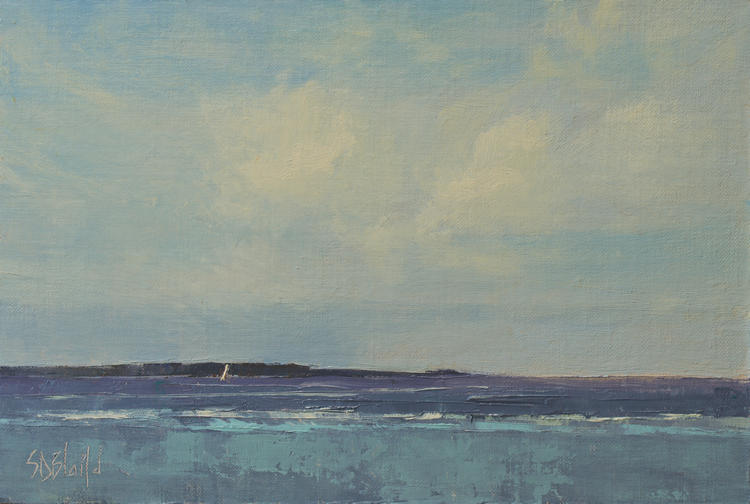
Updated painting of the sea at Carkeek Park, 10x10, oil on linen panel.
I removed the thin paint in the bottom part of the foreground and repainted it to add some texture. I also added new paint starting at the white line of breaking waves (which were also scraped back a little bit). The latter was done with some extra medium added because it was being laid down over an existing paint layer that I couldn't entirely remove.
Some of the existing paint in the sky was also too thick to remove fully. Instead, I scraped and sanded off the peaks, let it dry thoroughly, then repainted the sky in a layer of paint mixed with extra medium. The downside of doing this is that I lost the texture of the canvas in a few places, so I had to use paint texture to compensate. However, I think I got away with it.
Notice that I didn't repaint all of the sky; some parts near the horizon are the original paint layer which helped to maintain good control over the edge work.
2. (Dry, Small) Use for Studies
Unfortunately, most failed canvases or panels aren't worth reusing for paintings that you hope to sell. This is especially true if the existing paint is dry, thick or oil-rich as it might harm the overlying paint integrity. I also don't like to see the texture of an underlying paint layer in a finished painting, although your view may differ.
In these cases, I prefer to use the canvas to help try out my ideas for a painting or technique. The longevity of these sketches is unimportant.
Here are a couple of examples where I painted over something that was already there without worrying about the paint underneath:
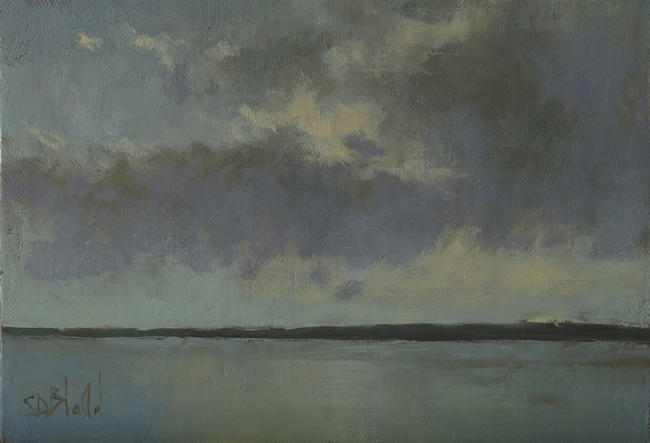
A sketch in oil paint of backlit clouds over Puget Sound. Approx. 9x12, oil on linen panel.
I can no longer remember what was originally on these panels, almost certainly abject failures.
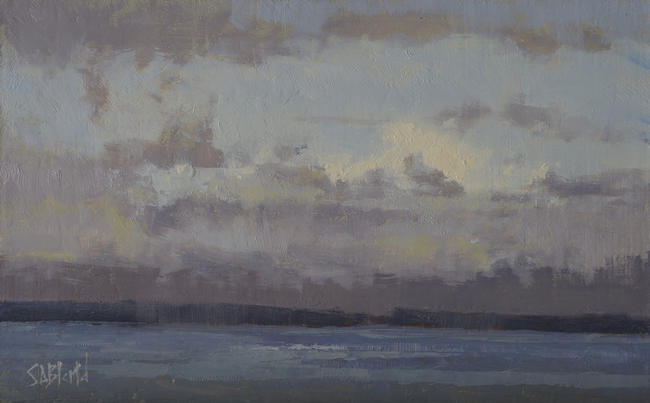
A sketch in oil paint of broken, scudding clouds over Puget Sound. Approx. 8x10, oil on linen panel.
If you want to start getting more out of your studies, I would recommend you don't just make a single study and then stop. I think you tend to develop ideas more completely if you create several studies at a time, one after the other — especially if you can make some variations on a theme. The studies I've shown here were part of a series like that.
I usually hang on to studies and sketches like these for a few years. I will refer back to them for inspiration or to inform an idea for elements of new painting — studies of clouds and tree silhouettes are especially useful for this purpose and any one of those objects might appear in many future works. Eventually I'll get to a point where I feel like I've either exhausted the idea or my style has evolved to a different place. At that point they get consigned to the trash can.
3. (Dry, Medium) Playground
Sometimes, I just like to play around with paint, especially if I can try out new brands or colors. Sometimes I might try to an emulate another artist's style to see how they created effects. It's often easier to do that on a mid-size canvas. In the example below, I just kept reusing a panel and painted over each layer of existing paint.
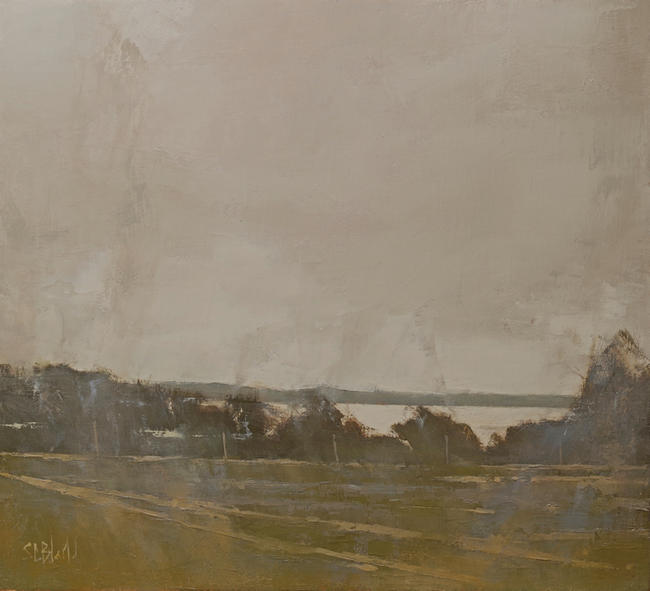
Tonal atmospherics in raw umbers. 12x12, gessoed panel.
After an initial abandoned attempt at a "finished" painting, this panel was used for experiments at creating atmospherics using different Cobra raw umbers which were new to my palette at the time (I got the inspiration for this from paintings by the Vermont artist, Charlie Hunter). This one went on for ages, by the way; I think the version you see here was the fourth or fifth iteration and it was on and off the easel for a few years.
4. (Dry, Large) Use for Idea Generation
I find that medium and large size canvases are much less reusable. I have scraped many of them down, but there are often too many artifacts remaining for them to be used for a serious piece of work (one to which I commit significant effort in the expectation of having a marketable product). Since larger paintings usually sell at a higher price, I also feel that I have an duty not to scrimp on materials and to ensure that the paint layers are sound.
That is not to say that any one large painting is not salvageable — it is often possible to rescue a painting by making small changes to it — but this article is about the cases where that has either been tried or the structural deficiencies in the design are so bad that it is not worth the effort.
The best use I've found to date for my large reject canvases is for idea generation. I use some raw umber paint to divide the canvas up into small areas. Then I paint a mosaic of small sketches, usually spending less than 30 minutes on each section. With luck, I might find an idea or two that's worth taking further.
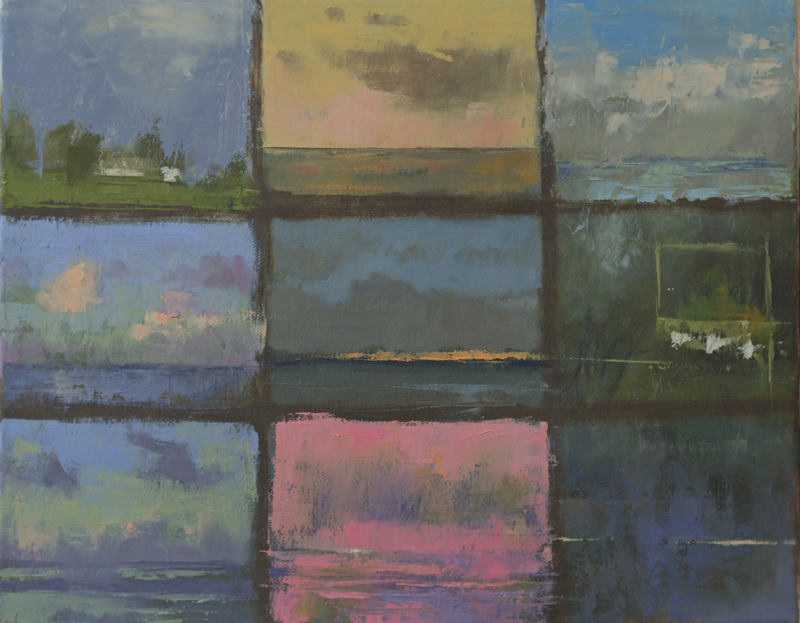
Multiple colorful oil sketches arranged in a grid pattern. 16x20, oil on linen.
The benefit of doing studies on a large canvas like this is that it encourages me to do more of them, and I'm a firm believer this is the best way to improve. New ideas arise from doing work. Quantity has a quality of its own.
Simon Bland: 12 Jun 2026