Ideas In Art
Simon Bland: 02 Oct 2026
My book Painting Animals in Oil is coming up on its 10-year anniversary, so I thought it might be a good idea to write some blog articles based on the contents. It's something that I've been meaning to do for a long time.
To start, I want to write about one of my favorite topics which is also the first chapter in the book. This article on Developing Ideas was rewritten for a blog audience and I've also taken the opportunity to explore some things in more depth.
One problem with trying to write about ideas is that I'm not sure that all artists would agree on a definition of idea. My own view is that it's the something that tells me what, how and why I'm going to paint. It may or may not involve a lightbulb appearing over my head, but more on that below. Usually, ideas come in response to some kind of inspiration, but sometimes they're just dreamed up out of thin air.
I used the term Developing Ideas on purpose because I don't want you to think that an idea must come as a "creative spark", i.e. in a flash, all at once. My best ideas have usually come when I've worked at them.
That said, let me show you what an idea might look like:
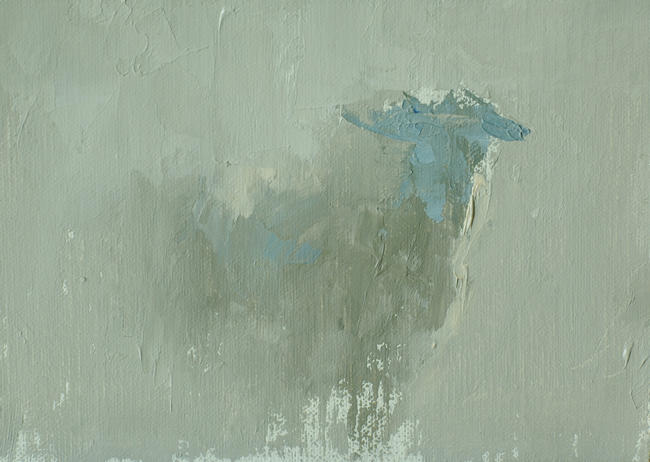
Sketch of an idea for painting a sheep. Approx. 4"x3" oil on linen.
I did this very small, abstract sketch as I was thinking about how to paint a sheep so that I could build around warm/cool temperature contrasts. It's just a simple way of trying to visualize a concept in real life before I start designing a picture or messing up a proper canvas, and it also helps me to see the picture as being about something other than the subject—in this case a cool triangle set in a foggy, diffuse light. Overall, it's mostly gray with some blue and a little bit of light.
I didn't do this in one go, there were other sketches before it (none of them as good as this one, unfortunately), but this one stood out because it was so sparse compared to the others. This is an idea that I kept working at and which I reused several times for other paintings of sheep.
Sketching out and refining ideas give me three benefits:
- gets me thinking about the picture as a unified whole right from the beginning
- lets me see the design as a few big shapes
- gives me some space to think about the abstract qualities of the painting (what the painting is about apart from the subject being painted)
Also, this leans heavily into my belief that the only way to consistently generate ideas is through work. If you think of an idea as coming at a "lightbulb" moment, the lightbulb almost always appears over my head when I'm making art of one form or another.
So my goal these days, is to always begin paintings with a a sketching-out-of-ideas process, no matter the source of my inspiration or how complete the picture already is in my mind. I do this for all types of paintings.
Having said all this, your own experience may be different! Your own ideas may arrive at the same moment at which inspiration strikes and you can start painting by the seat of your pants, developing the painting as you go. Many plein air painters work this way, for example (although I think this is one of the reasons why plein air painting is so difficult).
You have to find what works best for you, but if you take away just one thing from this article, I would encourage you experiment. To do that, start saving scraps of canvas, old panels and discarded canvases and use them to make small abstract sketches like the one above (I've written about this in the context of what to do with old canvases). Even if most of those don't go on to become a full-blown painting, there's no substitute for getting the creative juices flowing. If you keep working at it, you'll never run out of ideas.
Simon Bland: 02 Oct 2026